Frequently Asked Questions

  • About Children's Parachoc

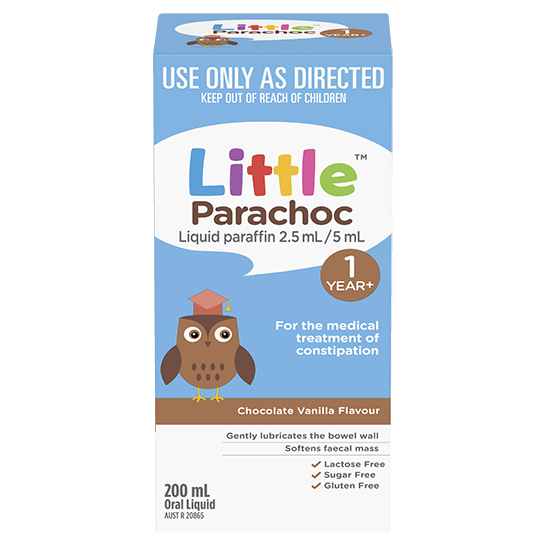
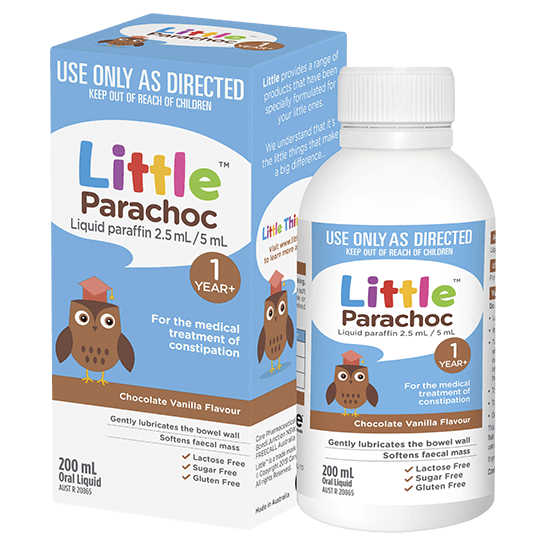
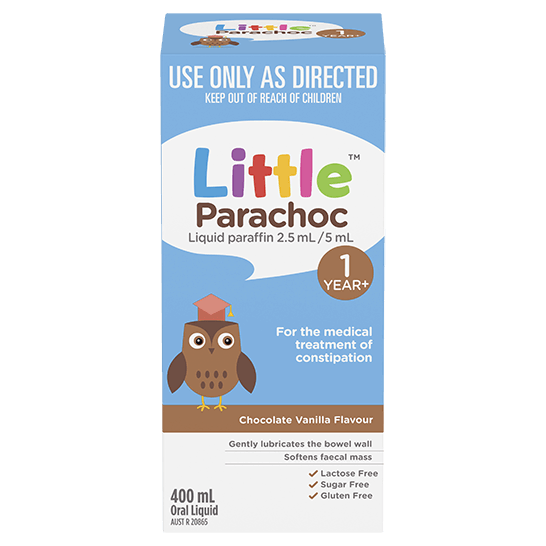
    1. How should Children's Parachoc be taken?

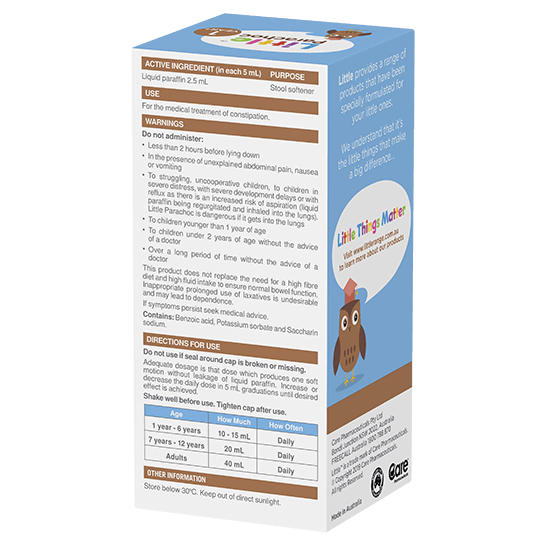
      Children's Parachoc should only be taken once a day.

      After taking Children’s Parachoc children should not lie down for at least two hours. This reduces the risk of the paraffin being regurgitated and inhaled into the lungs. Inadvertent inhalation of liquid paraffin can cause serious respiratory problems.

    2. What dose of Children's Parachoc should be used?

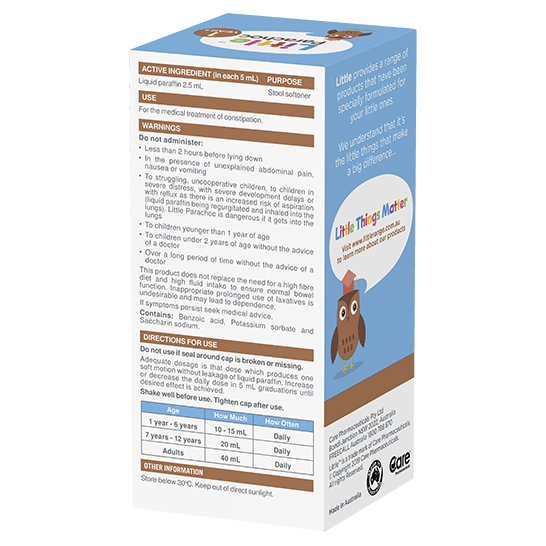
      Every patient has their own individual dose requirement for Children's Parachoc.We suggest the following starting doses and then the patient must proceed to find their correct dose by either increasing or decreasing, in 5mL amounts, the dose of Children's Parachoc taken. This process is continued until they obtain the passage of a soft motion without the leakage of paraffin oil.

      12 months - 6 years: 10mL to 15mL once a day

      7 years - 12 years: 20mL once a day

      Adults: 40mL once a day

      Because Children's Parachoc is not a bowel stimulant, patients must be aware that it can take up to 4 days for a change in dose to work. Therefore the new daily dose must be maintained for at least that time to assess how effective the change is. Further alteration may be necessary, and similarly a 4 day period should be allowed to assess that change before any further alterations in dose are made.

    3. What are the possible unwanted effects of Children's Parachoc?

      Leakage of paraffin oil may be observed and this is an indication that the dosage needs to be adjusted. If paraffin liquid is given in a very large dose there is a small possibility that there may be reduced absorption of some fat soluble vitamins. However, this is not a problem if you follow the dosage directions and only take Children's Parachoc once a day. Abdominal cramps may also be experienced.

    4. Can Children's Parachoc be taken while pregnant or while breast-feeding?

      Children's Parachoc can be used for short periods under the guidance of your doctor. 

    5. What happens if too much Children's Parachoc is taken?

      Should an overdose be taken, all that is likely to happen is that there will be short-term diarrhoea.
       

    6. When should Children's Parachoc not be taken?

      Children's Parachoc should not be used in the following circumstances:

      • presence of unexplained abdominal pain, nausea or vomiting.
      • by children in severe distress, with severe developmental delays or with reflux as there is an increased risk of aspiration (paraffin oil being regurgitated and inhaled into the lungs).

      Prior to long-term use of Children's Parachoc, underlying organic diseases should be excluded by a medical practitioner.

    7. How should Children's Parachoc be stored?

      Children's Parachoc must be stored under 30°C away from direct sunlight and out of both the reach and sight of children. Do not use after the expiry date shown on the pack. Ensure the cap is firmly screwed back on immediately after use.

    8. My child has allergies - how can I tell if Children's Parachoc is suitable?

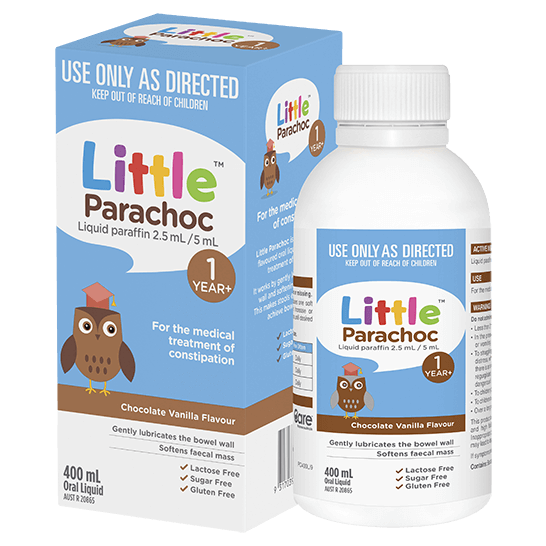
      Children's Parachoc does not contain the following:

      • Gluten
      • Lactose
      • Casein (milk protein)
      • Dairy
      • Egg
      • Soy
      • Nuts and nut by products
      • Peanuts and peanut by products

      If you would like to know about another ingredient please contact us.

    9. Is Children's Parachoc just a lubricant?

      Yes Children's Parachoc is a lubricating laxative and it softens the faeces and lubricates the bowel wall and the faeces allowing it to pass through easily. Since Children's Parachoc is a lubricant it takes a few days for it to work and it is usually used for long periods of time.

    10. How long should Children's Parachoc take to work?

      Children's Parachoc is a lubricant and it takes at least three days to soften the faeces. If you are not seeing any results after the fourth day you can increase the dosage by 5mLs. If it still doesn't work after four days increase the dosage by another 5mLs.

      If you see an oily discharge in your childs underwear then you can reduce the dose by 5mLs and wait for four days before reducing it again.

    11. Can Children's Parachoc be taken more than once a day?

      Please note that Children's Parachoc should only be taken once a day. It is also important that it is taken at least 2 hours before your child lies down.

    12. My child dislikes the taste of Children's Parachoc - can I mix it with anything?

      Yes Children's Parachoc can be mixed with the following:

      • Cold or warm milk (not hot)
      • Yoghurt
      • Cold or warm Milo (not hot)
      • Frozen and served like a ice-lolly

    13. Availability outside of Australia

      Unfortunately we only distribute Children's Parachoc in Australia. Please contact us directly for information on how to order it overseas. 

  • About Constipation

    1. What is constipation?

      Every child has different toilet habits. Constipation is defined as having difficultly passing stool. With constipation stools are usually hard, dry, small in size, and difficult to eliminate. Constipation is a symptom, not a disease. Understanding its causes, prevention, and treatment will help provide relief for most kids.

    2. What are the consequences to the bowel during constipation?

      As hard stool builds up it stretches the bowel larger than normal. The stretched muscles of the bowel’s wall cannot function properly to clear the bowel. If the bowel is not emptied, the muscles can’t regain their regular strength and so constipation continues.

    3. What can I do to relieve my child's constipation?

      First the hard mass of faeces must be passed. This may mean using softening agents, enemas and suppositories. Then the bowel must be kept empty. This is so the bowel has time to recover its normal muscle function. It’s important that faeces do not build up again until the bowel is functioning normally. To keep the bowel empty use a liquid lubricant laxative such as Children’s Parachoc.

  • About Encopresis

    1. What is encopresis?

      Encopresis is the inability to fully control the bowel, resulting in a soiling accident. This can occur in underpants and sometimes in the bath or pyjamas. It’s quite common – one child in every two or three primary school classes might have soiling difficulties.

    2. Why does faecal soiling occur?

      When the bowel can’t clear stool normally, it builds up in the large intestine. As the large intestine or rectum stretches it decreases the sensation of stool presence. With a child unaware they need to have a poo, the retained stool may leak out and a soiling accident happens.

    3. What causes encopresis?

      There are several causes including the following:

      • A lack of muscle co-ordination in the lower bowel (rectum) and anus. This makes full and effective evacuation of faeces difficult.
      • A lack of sensitivity or feeling in the rectum so a child can’t tell they need to have a poo. This leads to a build up of stool which can then leak out.
      • Some children are afraid of pooing because it hurt during past episodes of constipation. They may resist the urge to go to the toilet leading to stool build up.

    4. My child has encopresis - how can I help?

      A programme of regular sits on the toilet along with the help of a stool softener such as Children’s Parachoc will help more than 2 out of 3 children within 6 months and make more than 9 out of 10 children feel much better.

      The treatment for encopresis is similar to that recommended for constipation:

      • emptying the large intestine;
      • establishing and maintaining regular bowel movements.

      A healthy diet with adequate fibre (from cereal, fruit and vegetables) and drinking plenty of water or fruit juice will also help.